The Role of LSF in Industrialising Rural Construction in Iran

In this article
Research paper · Author: Mahmood Karami · Indexed on CIVILICA
Abstract
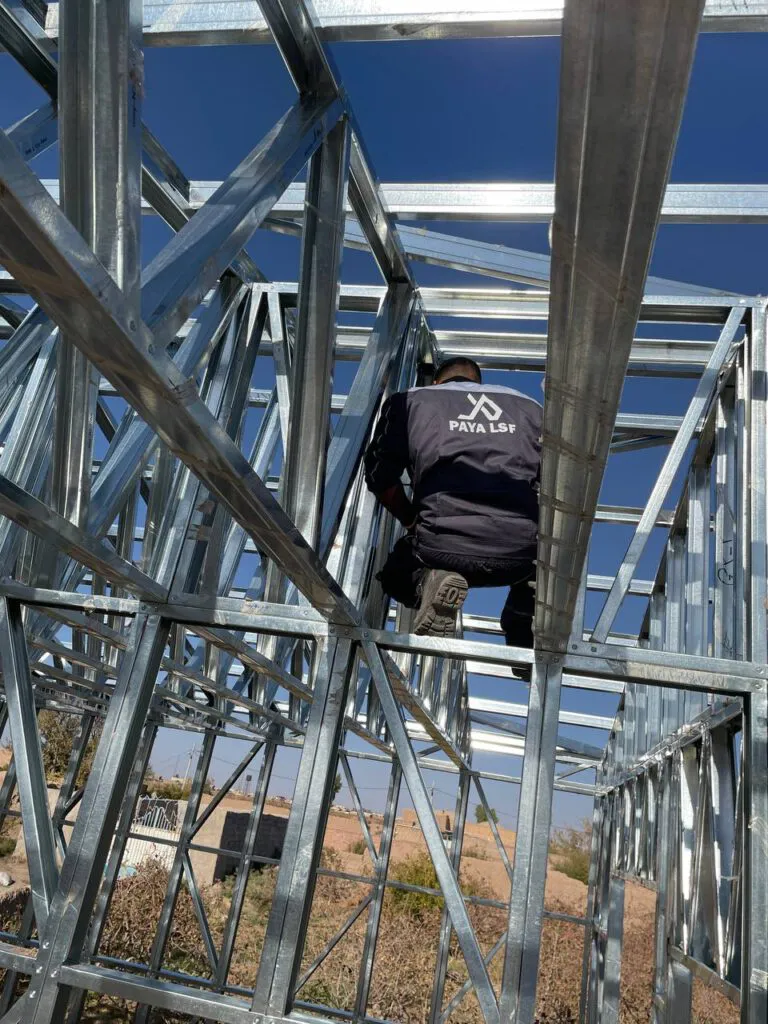
Iran's building sector consumes more than 40% of the country's final energy each year, while wasting a significant share of national capital by sticking to traditional construction methods. The Housing Foundation of the Islamic Revolution, the largest builder of rural housing, built, strengthened or rebuilt more than 230,000 rural homes in 1402 (2023–24) and plans another 350,000 in 1403 (2024–25); yet more than 95% of these homes are still built with resource-hungry tie-beam masonry and conventional concrete frames, which bring high use of water, energy, cement and brick, long build times, weak seismic performance and a short service life. Light steel frame (LSF) technology, one of the most efficient industrialised building systems, cuts structural weight by up to 60%, build time by up to 70% and operational energy use by 35–45%, reduces water use during construction by up to 78%, keeps material waste below 5% and offers very high seismic resistance. Using a descriptive-analytical method, and drawing on official Housing Foundation statistics (1401–1403), reports from the Road, Housing and Urban Development Research Center and Iran's energy efficiency organisation, and cost-benefit studies of several pilot LSF projects in different provinces, this study shows that even in a conservative scenario where only 30% of the Housing Foundation's annual projects move to LSF, more than 1.2 billion litres of water and 350,000 tonnes of cement and brick would be saved each year, along with the equivalent of 12 billion cubic metres of natural gas over the buildings' lifetime and more than 20,000 billion tomans of national capital. The findings indicate that starting industrialisation with public rural projects is the lowest-cost, fastest and most effective way to manage national capital and energy and to make villages safer against earthquakes.
Full paper
Related services
From reading to building.

More articles